

When you run a business, unpaid invoices are frustrating but bad debts written off feel like a final blow. Many business owners believe that once a debt is written off in their accounting system, it’s gone forever. In reality, written‑off debt can still be legally recoverable, provided it’s within the limitation period and supported by proper documentation.
This guide explains what “bad debts written off” really means, whether they can be recovered, how debt collection agencies handle them, and how to prevent future losses.
What Does “Bad Debts Written Off” Mean?
A bad debt written off is a debt your business no longer expects to recover and has removed from its accounts receivable ledger. This usually occurs when:
- The debtor has been unresponsive over an extended period.
- Internal recovery efforts have failed.
- The debt is deemed too old or too costly to chase.
- The debtor’s business has closed or entered insolvency.
This is an accounting step, not a legal ruling. A written‑off debt can still exist as a legal obligation unless it becomes statute‑barred.
The Difference Between an Overdue Invoice vs Bad Debt Written Off
Overdue Invoice
Still considered collectible, actively followed up.
Bad Debt Written Off
Removed from your active books for accounting accuracy but may still be enforceable.
Why Businesses Choose to Write Off Debt
Businesses write off debts to present accurate financial statements, reduce administrative effort, and claim tax deductions where appropriate. It does not mean collection is impossible only that the business has accepted the loss financially.
Accounting for Bad Debts Written Off
From an accounting point of view, a written‑off debt is expensed to reflect the reduced asset value. Note: This is not financial advice always speak with a qualified accountant.
Can Bad Debts Written Off Still Be Recovered?
Misconception: Written-Off Debt Is Gone Forever
Many assume a written‑off debt “disappears”. But legally, debt remains payable unless:
- The debtor has obtained bankruptcy protection.
- The debt becomes statute‑barred (limitation period expired).
Legal Enforceability
A written‑off debt can still be pursued as long as it sits within the relevant statute of limitations, which determines how long creditors can take legal action. The Australian Consumer Law and state limitation acts define these limits.
The general limitation period for simple contract debts (e.g., invoices, service agreements) is 6 years in most Australian states and territories, except Northern Territory (3 years).
A court judgment (if obtained) can extend enforceability to 12 years in many jurisdictions.
When Is a Debt Considered “Statute-Barred”?
A debt becomes statute‑barred when the limitation period expires. At that point:
- Creditors generally cannot take legal action to enforce it.
- Debtors have a complete legal defence if sued.
- Collectors must avoid misleading or pressuring the debtor, as required under ASIC/ACCC guidelines.

How Debt Collection Agencies Recover Bad Debts Written Off
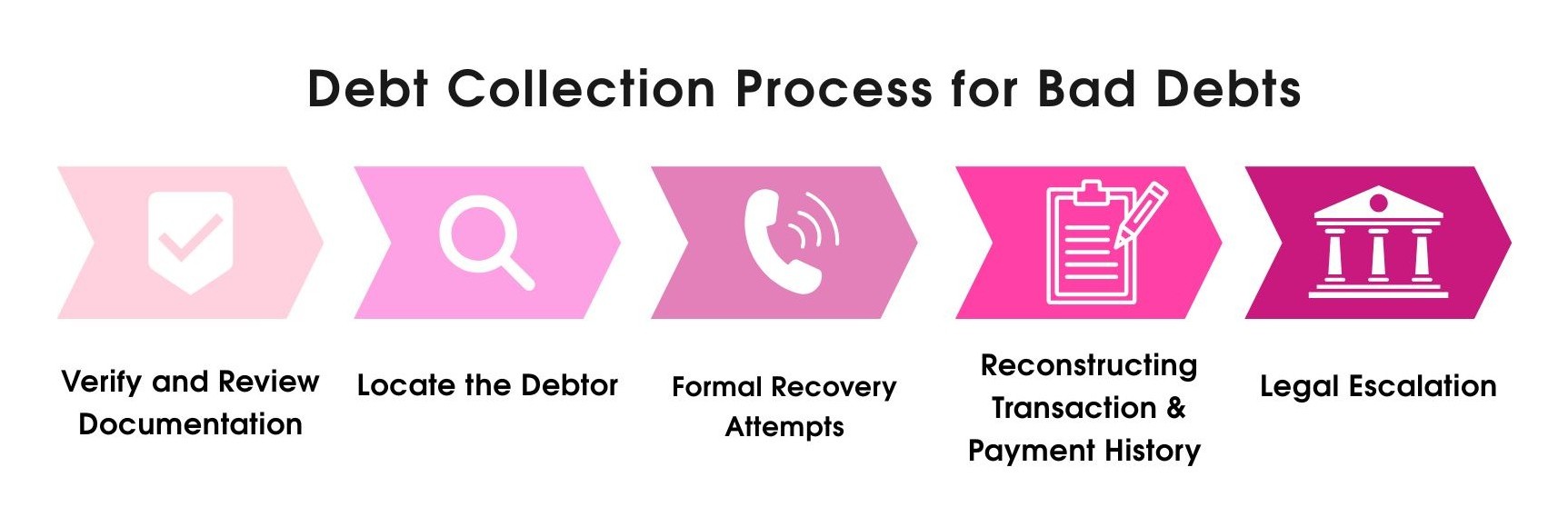
Even older debts can often be recovered with a structured, compliant process. Here is a Step-by-step professional recovery process.
Step 1 – Verifying and Reviewing Documentation
Agencies begin with a thorough evidence check:
- Contracts or service agreements.
- Invoices and account statements.
- Proof of delivery or completion.
- Previous communication.
- Notes on disputes or non‑payment claims.
Clear documentation is essential for recovering older debts and avoiding disputes. Agencies ensure records meet guidelines set under Australian Consumer Law and the ACCC/ASIC debt collection framework.
Step 2 – Locating the Debtor (Skip Tracing)
A major challenge in older debts is that debtors often relocate or close businesses.
Agencies use lawful skip‑tracing tools, such as:
- Public records.
- Commercial databases.
- ASIC business registers.
- Online searches.
- Cross‑referenced contact information.
Skip tracing complies with the Privacy Act 1988 and Australian Privacy Principles, which require collectors to gather only necessary information and avoid unauthorised disclosure of personal details.
Step 3 – Formal Recovery Attempts
Once contact is re‑established, agencies initiate formal collection efforts:
- Demand letters.
- Polite but firm phone follow‑ups.
- Structured negotiation.
- Payment plans or settlement discounts.
Collectors must follow the strict behavioural rules under the ACCC/ASIC guideline, no misleading conduct, no harassment, and contact only for reasonable purposes.
Step 4 – Reconstructing Transaction & Payment History
For older written‑off debts, the agency may need to reconstruct the account:
- Confirming dates of last payment or acknowledgement (critical for limitation periods).
- Establishing a clear timeline of the debt.
- Identifying any disputes or credits.
Accurate reconstruction ensures the debt is still enforceable and compliant with legal standards, preventing breaches of the ACL.
Step 5 – Legal Escalation (If Required)
If the debtor refuses to pay despite reasonable attempts, agencies may recommend legal action via partner solicitors.
Court process basics include:
- Issuing a Statement of Claim.
- Allowing the debtor time to respond (usually 28 days).
- Applying for default judgment if unchallenged.
- Enforcing judgment (writs, garnishees, property seizure).
Legal action is only possible if the debt is within the limitation period. Once expired, the debt becomes statute‑barred and unenforceable.
Common Challenges When Recovering Bad Debts Written Off
Missing Paperwork
Older debts often lack clear terms, signed agreements and delivery evidenceThis makes enforceability more difficult.
Insolvency Claims
If the debtor has entered personal bankruptcy or company liquidation, recovery options may be extremely limited.
Business Closures / Cross‑Border Cases
Closed companies, dissolved entities, or overseas relocations complicate recovery.
Limitation Periods
The biggest barrier: if the 6‑year (or 3‑year in NT) period has passed and the debtor has not made a payment or acknowledged the debt, it becomes statute‑barred.
Costs of Recovering Written-Off Debt
Commission-Based Fees
Most agencies charge a commission on recovery.
Legal Fees
If the matter requires litigation, separate solicitor fees, filing costs, and enforcement costs apply.
Why Older Debts Cost More
Older debts require:
- More investigative work.
- Document reconstruction.
- Skip tracing.
- Higher dispute likelihood.
As debts age, recovery becomes harder statistics show recovery probability drops sharply after just 12 months overdue.
Benefits of Using a Professional Debt Recovery Agency
Higher Recovery Success Rate
Agencies use structured processes backed by regulatory guidelines, improving outcomes even for older debts.
Faster Results
Agencies apply consistent, time‑efficient escalation essential for reviving stale accounts.
Compliance and Reduced Risk
Collectors must follow strict rules including the ACCC/ASIC Debt Collection Guideline, Australian Consumer Law (no harassment, no coercion) and the Privacy Act 1988 and APPs (data handling).
Protecting Relationships and Reputation
Professional collectors communicate respectfully, helping preserve future business where possible.

When DIY Recovery Isn’t Recommended
Complex Disputes
Old debts frequently involve disputes about:
- Contract terms.
- Delivery quality.
- Timing.
- Payment application.
Professionals can separate facts from emotion.
High Emotional Involvement
Chasing an old debt yourself can feel personal, risking confrontation or non‑compliant behaviour.
Potential Legal and Compliance Issues
DIY attempts may inadvertently breach:
- Contact frequency rules.
- Privacy laws.
- Limits on what collectors can say or threaten.
Agencies ensure all communication remains lawful.
How Pink Door Helps Businesses Recover Bad Debts Written Off
Commercial & SME Experience
We specialise in small‑to‑medium business debts, including long‑overdue and previously written‑off accounts.
Proven Recovery Framework
Our process includes:
- Documentation review.
- Skip tracing.
- Formal recovery attempts.
- Payment negotiation.
- Legal referral if viable.
This framework improves recovery chances even for older debts still within the limitation period.
Ethical, Compliant Approach
Pink Door adheres strictly to ACCC/ASIC guidelines, no aggressive conduct, respectful communication, transparent steps.
Our Values

Respect
Treating everyone with dignity, regardless of circumstances.

Professionalism
Maintaining a high standard of conduct and quality in all operations.

Transparency
Prioritize clear communication and openness, ensuring all parties have a full understanding of processes, fees, and expectations.

Reliability
Building trust by consistently delivering dependable results.

Adaptability
Adjusting approaches to meet the unique needs of each client and case.

Collaboration
Approaching all cases with understanding and kindness.
Final Tips to Avoid Future Bad Debts
- Conduct credit checks on new clients.
- Request deposits or progress payments .
- Implement automated reminders and follow‑ups.
- Review overdue accounts quickly, recovery probability drops dramatically after a few months.
A written‑off debt is not necessarily a lost debt.
If it remains within the legal limitation period and you have sufficient documentation, it can often still be recovered, sometimes years later.
If you have old accounts you’d like to revisit, speak to a professional debt recovery specialist. Pink Door can assess your case and guide you through the most effective, compliant recovery strategy.
