Process serving is a critical step in Australian legal proceedings, ensuring individuals and businesses receive formal notice of court actions. This is necessary for procedural fairness and for cases to progress without delay. Proper, lawful service ensures parties have the opportunity to respond an essential requirement under Australian justice principles.
Professional process servers play a key role in delivering documents reliably and in compliance with court rules across states and territories. Due to strict procedural requirements, incorrect or late service can cause adjournments, dismissal of cases, or additional legal costs.
What Is Process Serving?
Process serving is the formal delivery of legal documents to a person or organisation involved in a legal matter. It ensures all parties receive lawful notification of proceedings and can respond appropriately, reinforcing procedural fairness.
Why Proper & Timely Service Matters
Timely service:
- Ensures legal proceedings move forward.
- Protects the right to be informed.
- Prevents dismissal or costly delays due to improper service.
Common Documents Served
Process servers in Australia commonly deliver:
- Statements of Claim.
- Court summons and complaints.
- Divorce and family law documents.
- Statutory demands and bankruptcy notices.
- Court orders, enforcement notices & subpoenas.
These documents often have strict deadlines, making timely service essential.
How Process Serving Works in Australia
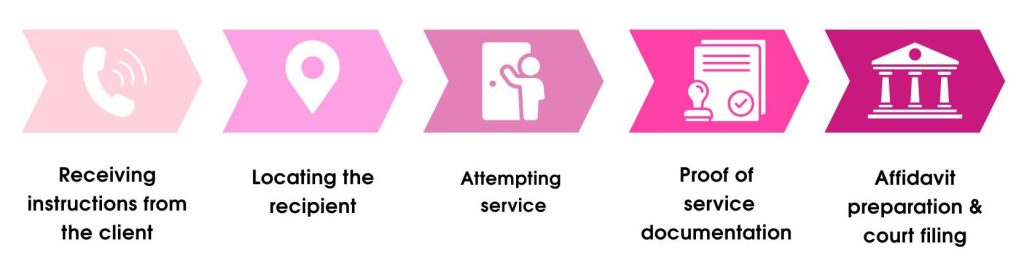
Step 1 — Receiving instructions from the client
The process begins when a client often a law firm, creditor, government body or individual provides the documents and instructions. Professional agencies verify details, confirm deadlines, and assign a local licensed field agent.
Step 2 — Locating the recipient
Sometimes recipients are easy to reach; other times, they may have moved or are intentionally avoiding service. Agencies may perform skip tracing, using lawful public records and verified data to locate the correct person or business before attempting service.
Step 3 — Attempting service
Personal Service
The process server physically hands documents to the named individual, identifies the recipient, and explains the nature of the documents. Personal service is the primary and preferred method.
Substituted Service
If personal service is impractical (e.g., the recipient is avoiding service), courts may permit substituted service, allowing delivery to another person, business address, or via electronic/alternative means – subject to court approval.
Service by Post or Electronic Means
Many state rules allow postal or electronic service under specific conditions (e.g., NSW UCPR rules for postal or electronic service).
When Can a Process Server Serve Papers?
While each state may have practical norms, process servers generally operate within reasonable hours, avoiding late-night or intrusive attempts. Courts focus not on specific hours but on ensuring service is fair, lawful, and not harassing. Requirements vary slightly by jurisdiction under local civil procedure rules.
Step 4 — Proof of service documentation
After successful service, the server prepares a Certificate of Service or Proof of Service, detailing:
- Date and time served.
- Method of service.
- Identity confirmation steps.
Step 5 — Affidavit preparation & court filing
For documents requiring formal verification, an Affidavit of Service is prepared and may need witnessing before filing with the court. This affidavit confirms service was carried out correctly and allows the legal matter to progress.
Who Can Serve Legal Documents in Australia?
Professional Process Servers
Licensed field agents deliver documents across all states and territories, ensuring legal compliance and documentation.
Law Firms & Lawyers
Some legal practitioners provide in‑house service or engage external process servers.
Sheriff’s Office
In certain jurisdictions, sheriffs or court bailiffs may be responsible for serving specific types of documents.
Restrictions
Generally, a party to proceedings should not personally serve certain documents (especially family law), which must be served by a third party to avoid bias.
Legal Requirements for Process Serving (State-by-State)
Australia’s federal structure means each jurisdiction has its own rules.
New South Wales
- Governed by the Uniform Civil Procedure Rules 2005 (UCPR)
- Personal service primary; postal/electronic service allowed under Rules 10.5 & 10.6.
- Non‑compliance may lead to dismissal or stay of proceedings.
Victoria
- Governed by Supreme Court (General Civil Procedure) Rules 2015.
- Substituted service allowed under court approval.
- Non‑compliant service may be set aside.
Queensland
- Governed by Uniform Civil Procedure Rules 1999.
- Personal, postal & electronic service permitted.
- Non‑compliance may void service or judgments.
Western Australia
WA courts have similar rules to other states for personal and substituted service (General principle derived from Australia‑wide court procedure guidance).
South Australia, Tasmania, ACT & NT
- Follow similar civil procedure frameworks allowing personal, postal, and substituted service, each with particular procedural rules enforced by local courts.
Identity Verification Requirements
Asking for name confirmation.
- Relying on physical likeness to provided photos.
- Verifying business details for company service.
- Rules for personal vs substituted service.
- Identity verification requirements.
Court rules governing procedural compliance.

Types of Service Allowed Under Australian Law
Personal service
Direct handover to the named recipient.
Best for: Court summons, subpoenas, family law documents.
Substituted service
Allowed by court order when personal service has failed despite reasonable attempts.
Examples:
- Serving a spouse via employer email.
- Posting documents to a last known address.
Service by post or electronic means
Only permissible under relevant civil procedure rules or court permission.
Service to companies & registered businesses
Documents can be served:
- At the company’s registered office.
- On a company director.
- Via ASIC‑recorded contact details.
Cost of Process Serving in Australia
Process serving costs vary depending on distance, urgency, and document type. Many agencies offer fixed fees for standard service, which include:
- Multiple attendance attempts.
- Certificate or affidavit of service.
Factors Affecting Pricing
- Location: Rural or remote areas often incur extra travel fees.
- Urgency: Same‑day or priority service typically costs more.
- Attempts Required: More attempts increase cost.
- Skip Tracing: Additional fees if the recipient must be located first.
Additional Charges
- Affidavit preparation fees.
- Document retrieval.
- Surveillance (for evasive respondents).
How Long Does Process Serving Take?
Standard Timeframes
Most process services are completed within a few days, depending on the location and recipient availability.
Urgent Same-Day Service
Professional networks often offer same‑day or urgent service across metro areas.
Remote or Rural Areas
Regional or remote locations may require additional time due to travel and limited agent availability.
Court Filing Deadlines
Documents must be served before specific deadlines (e.g., response dates, hearing dates). Failure to serve in time can invalidate the proceeding.
What Happens if Someone Avoids Service?
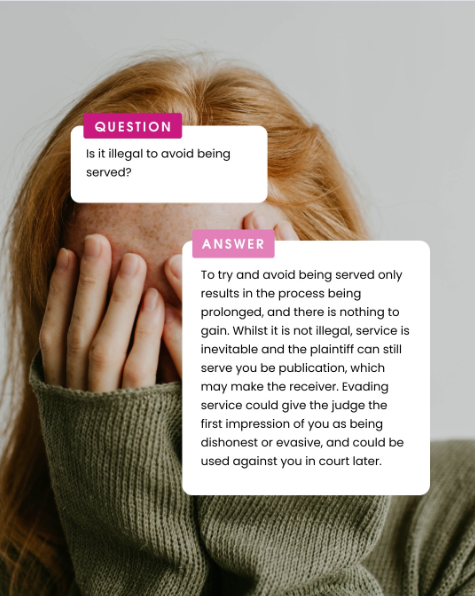
Signs the Person Is Actively Avoiding Service
Process servers often identify avoidance behaviour through repeated patterns such as:
- Not answering the door despite lights on, cars present, or visible movement inside.
- Repeatedly “just missing” the server after being informed of attempts.
- Refusing to collect mail or sign for registered post.
- Providing false or outdated addresses to agencies, employers, or creditors.
- Neighbours or co‑residents stating “they’re never home” despite evidence to the contrary.
- Social media activity indicating they are home or active locally while denying availability.
Steps Professional Servers Can Take
A licensed process server can use a range of lawful strategies to continue attempting service, including:
- Attending at different times of day (early morning, evenings, weekends).
- Observing the property to confirm occupancy patterns.
- Making enquiries with neighbours, property managers, employers, or known associates.
- Checking public records, ASIC, electoral roll (where permitted), and skip‑tracing databases.
- Attempting service at multiple possible addresses (residential, work, or known frequent locations).
- Using social media or digital footprints to verify updated contact details.
These steps help establish reasonable efforts prior to requesting alternative service.
Applying for Substituted Service
If personal service isn’t possible due to deliberate avoidance, the applicant can ask the court for a Substituted Service Order.
This allows documents to be served in another manner that is reasonably likely to bring them to the person’s attention, such as:
- Email service.
- SMS or messaging app service.
- Posting to a known address.
- Delivering to a relative or co‑resident.
- Service via social media (in some jurisdictions).
- Affixing documents to a front door or leaving them in a mailbox.
Courts generally require proof that ordinary service is impractical and that the proposed method is likely to be effective.
Requirements for Evidence of Reasonable Attempts
To succeed in a substituted service application, evidence usually includes:
- A detailed affidavit from the process server outlining each attempt, including dates, times, observations, and conversations.
- Proof that the address used is correct (e.g., utility bills, ASIC records, lease documents, employer details).
- Notes showing patterns of avoidance (e.g., lights turning off when the server approaches, or confirmed presence inside).
- Evidence of alternative locations checked (workplace, previous addresses, known associates).
- Screenshots of digital activity suggesting the person is contactable online.
- Confirmation that no other practical method of personal service is available.
Courts want to see that all reasonable avenues have been exhausted before allowing substituted service.

Why Use a Professional Process Server?
Hiring a professional ensures:
- Legal compliance: Prevents invalid service and rejected affidavits.
- Neutrality: Independent third‑party avoids conflicts.
- Speed and accuracy: Trained agents deliver faster results.
- Court‑ready documentation: Proper affidavits and proof of service.
Lawful process serving is essential for the smooth progression of legal matters. With strict court rules across Australian states and territories, professional process servers ensure documents are delivered correctly, on time, and with complete compliance.
Whether you need urgent service, rural delivery, or assistance locating a hard‑to‑find respondent, licensed process servers provide accuracy, speed, and peace of mind.
Need documents served quickly and lawfully?