Unpaid commercial invoices aren’t just a minor annoyance they impact cash flow, disrupt operations, and erode profitability. A structured and compliant commercial debt recovery process helps businesses recover overdue amounts efficiently while staying aligned with Australian legal and regulatory requirements.
This blog post breaks down what commercial debt recovery is, why business debts occur, the complete step‑by‑step process, and the laws that govern how companies and agencies must operate.
What Is Commercial Debt Recovery?
Commercial debt recovery refers to the process of collecting unpaid business‑to‑business (B2B) debts, usually arising from invoices, supply contracts, service agreements, or trade credit.
Definition & Purpose
The purpose of commercial debt recovery is to recover overdue payments while maintaining professionalism, compliance, and business relationships. It applies to business debts, not consumer debts, and typically involves larger amounts or complex contractual relationships.
Difference Between Commercial vs Consumer Debt
- Commercial debt involves two businesses, governed by contract law, industry practices, and commercial arrangements.
- Consumer debt involves a business and an individual, subject to additional consumer‑protection rules.
While both must follow ACCC and ASIC conduct expectations, commercial debts often involve more significant documentation, negotiations, and legal considerations.

Why Unpaid Business Invoices Occur
Common causes include:
- Internal cash-flow issues.
- Unclear contract terms.
- Delivery or scope disagreements.
- Administrative errors.
- Poor debtor communication systems.
Impact on Business Performance & Cash Flow
Commercial debts directly affect:
- Cash flow and working capital.
- Budgeting accuracy.
- Supplier obligations.
- Ability to reinvest or scale.
- Administrative workload for chasing payments.
Why Companies Face Commercial Debts
Common Causes
Payment disputes & service disagreements
Misunderstood scope, quality issues, or unclear terms often lead to disputes.
Cash flow problems within debtor businesses
Many businesses delay payment to manage their own finances, especially in tight economic conditions.
Poor documentation / unclear terms
Without clear contracts and delivery records, disputes escalate quickly.
Supply chain and delivery confusion
Delays, partial deliveries, or miscommunications frequently lead to non‑payment.
Business Impact of Unpaid Commercial Debts
- Cash flow disruption: Limits operational flexibility.
- Increased operational burden: Chasing debt drains time and staff resources.
- Risk to supplier relationships: Unpaid invoices create tension and distrust.
- Administrative load & costs: More follow‑ups, reconciliations, and legal prep.
Step-by-Step Commercial Debt Recovery Process
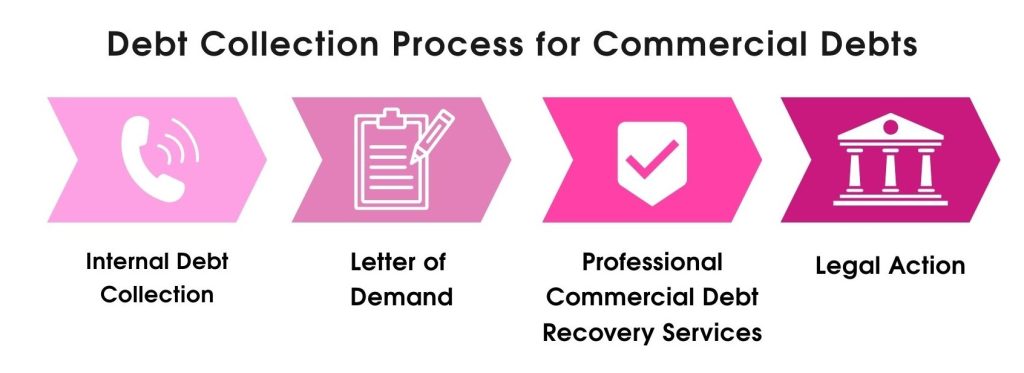
Step 1 – Internal Debt Collection
Before escalation, businesses should follow structured internal processes:
- Reminder emails: Friendly → overdue → final reminder.
- Phone calls: Clarify reasons, confirm delivery, negotiate early payment.
- Structured timeline: E.g., reminders at 7, 14, and 30 days.
- Final notice: A clearly worded last attempt before external escalation.
Step 2 – Letter of Demand
A Letter of Demand is a formal written request outlining:
- Amount owed.
- Reason for the debt (contract, supply, invoice reference).
- Payment deadline (typically 7–14 days).
- Notice of potential legal action.
Demand letters must follow the ACCC/ASIC guidance, which prohibits misleading statements and requires respectful, lawful communication.
Step 3 – Using Professional Commercial Debt Recovery Services
Once internal efforts fail, a professional agency conducts:
Case assessment & documentation review
Contracts, invoices, proof of delivery, communication history.
Negotiation, mediation & settlement strategies
Agencies use trained negotiators following compliant communication standards.
ACCC/ASIC guidelines emphasise honesty, accuracy, no harassment, and reasonable contact frequency.
Skip tracing for missing debtors
If the business has moved or changed directors, agencies use lawful search tools.
This must comply with the Privacy Act 1988, requiring fair collection of personal information and secure handling.
Payment plans & structured solutions
Instalments, staged settlements, or revised terms when appropriate.
Step 4 – Legal Action
Legal escalation becomes appropriate when:
- The debtor refuses to engage.
- Disputes are complex.
- The debt is high‑value.
- A clear breach of contract has occurred.
Court claim process overview
- Filing a Statement of Claim in the correct jurisdiction.
- Debtor has 28 days to respond.
- Potential outcomes:
Payment.
Negotiated settlement.
Defence lodged.
Default judgment.
Legal action must occur before the statute of limitations expires, generally 6 years for simple contract debts (3 years in NT).
Legal Rules for Commercial Debt Recovery in Australia
ACCC & ASIC Guidelines
The joint ACCC/ASIC Debt Collection Guideline sets clear expectations for all collectors, including businesses chasing commercial debts.
Key rules include:
- No harassment, coercion, or misleading conduct.
- Only contacting debtors for legitimate purposes.
- Respecting contact frequency and time‑of‑day guidelines.
- Providing truthful, accurate information at all times.
Privacy & Documentation Obligations
Under the Privacy Act 1988 and APPs, businesses must:
- Collect only necessary information.
- Store data securely.
- Not disclose debtor details without legal basis.
- Notify individuals when information is collected from third parties.
Contract & Payment Term Requirements
Clear contracts are critical in commercial recovery. Essential components:
- Signed terms & conditions.
- Scope of work or supply.
- Payment schedule.
- Proof of delivery, acceptance, or completion.
- Documentation of variations or disputes.
These documents are vital if matters escalate to court.

Best Practices for Effective Commercial Debt Recovery
Well-Structured Credit Policies
- Written terms, deposits & milestones.
- Written terms.
- Deposits or milestone payments.
- Interest or late fees where legally permissible.
- Defined credit limits.
Strong Documentation & Record-Keeping
- Contract templates.
- Delivery receipts and evidence trails.
- Signed contracts.
- Delivery dockets.
- Acceptance confirmations.
- Email and call logs.
Clear evidence improves recovery success.
Active AR Management
- Automated reminders & overdue follow-up.
- Monthly credit control reviews.
- Automated reminders.
- Overdue escalation rules.
- Monthly credit control reviews.
Outsourcing to Commercial Debt Recovery Solutions
Benefits include:
- Higher recovery rates.
- Faster turnaround.
- Full compliance with Australian law.
- Reduced admin and legal risk.
When Should a Business Use Commercial Debt Recovery Services?
Businesses should consider professional help when:
- Internal efforts are exhausted.
- The debtor becomes unresponsive.
- The debt is high‑value or complex.
- There is a need for legal guidance.
- Skip tracing or mediation is required.
How Professional Agencies Improve Recovery Results
Professional recovery firms provide:
- Skilled negotiation: Case‑by‑case strategy to achieve payment.
- Skip tracing technology: Locating changed or dissolved entities.
- Legal compliance: Ensuring contact stays within ACCC/ASIC rules.
- Structured timelines: Faster, disciplined escalation for better outcomes.
How to Prevent Future Commercial Debts
- Conduct pre‑engagement credit checks.
- Use clear contracts and payment terms.
- Request deposits or progress payments.
- Automate invoicing and reminders.
- Involve recovery specialists early for overdue accounts.
A structured, compliant commercial debt recovery process is essential to protect your business’s cash flow, profitability, and long‑term stability. By following Australian regulations, maintaining strong documentation, and acting promptly, companies dramatically improve their chances of recovering overdue commercial debts.
Professional agencies provide the negotiation skills, compliance knowledge, and legal pathways required to maximise recovery outcomes.
Need help with commercial debt recovery? Speak with a specialist or request assistance now.